
You finally lock in a band rehearsal date. It took two weeks of back-and-forth just to find a day everyone was free. You've got your guitar, the drummer brought their kit, someone remembered the keyboard stand.
And then before you play a single note, twenty minutes disappear into the void.
One person forgot to print the charts. Another has them on their phone but the screen keeps dimming every thirty seconds. Someone found a version online that's in a different key. The bassist has everything on a tablet propped against their amp, which no one else can see from where they're standing.
You haven't played a note yet and it already feels like homework.
If you've ever played in a band, an ensemble, or even a casual living room jam, you know this feeling. It's almost a rite of passage at this point. We just accepted it as part of playing music with other people.
We didn't think it had to be.
The sheet music problem
Printed sheet music has been the standard forever, and it works well enough until it doesn't. You bring a binder, stuff it with charts, scribble notes in the margins from last week's rehearsal.
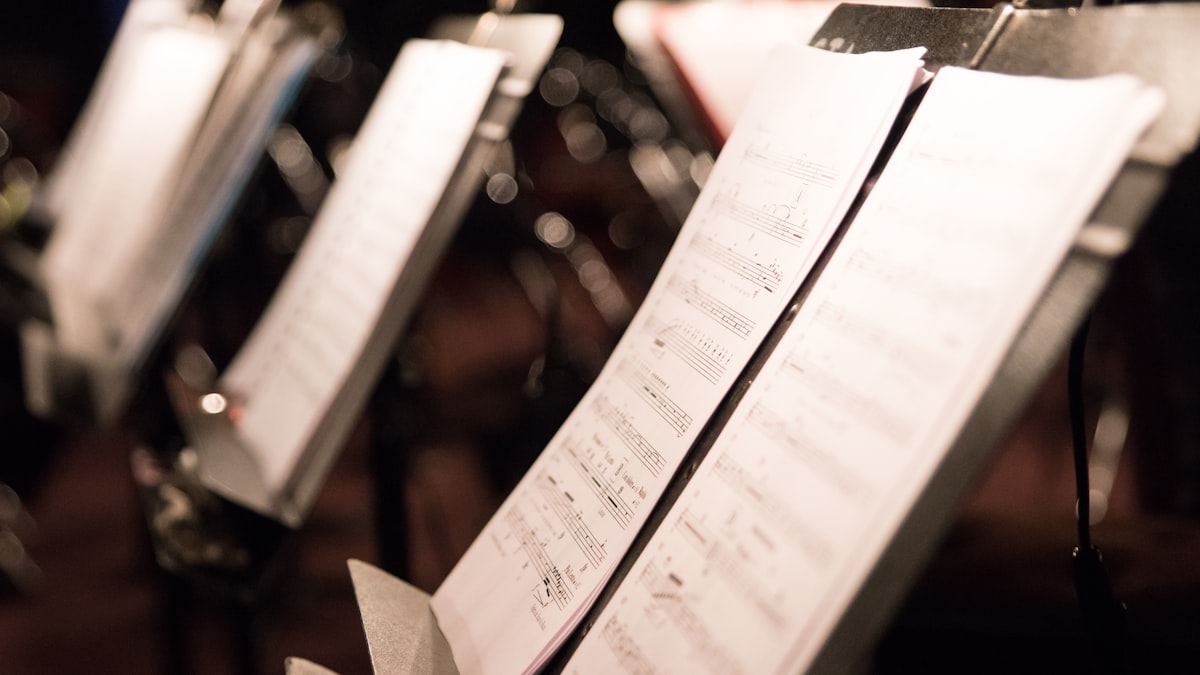
The binder, the charts, the scribbled margins — paper's limitations haven't changed.
The obvious problem is that paper doesn't update. Transpose a song, change a tempo marking, add a repeat section, and you're back at the printer. Then you're handing out new copies and hoping everyone swaps the right pages.
With five musicians in a room, every one of them has their own pile of sheets. And those piles have a way of quietly diverging over time. Someone's copy is missing page 3. Someone else has the old coda that got cut two months ago. Nobody figures this out until bar 47 when half the band stops and the other half keeps going.
Going digital helped, sort of
The move to phones and tablets made a lot of this easier. Hundreds of pieces in your pocket, no reprinting, no losing page 12 in the backseat of someone's car. Real improvements.
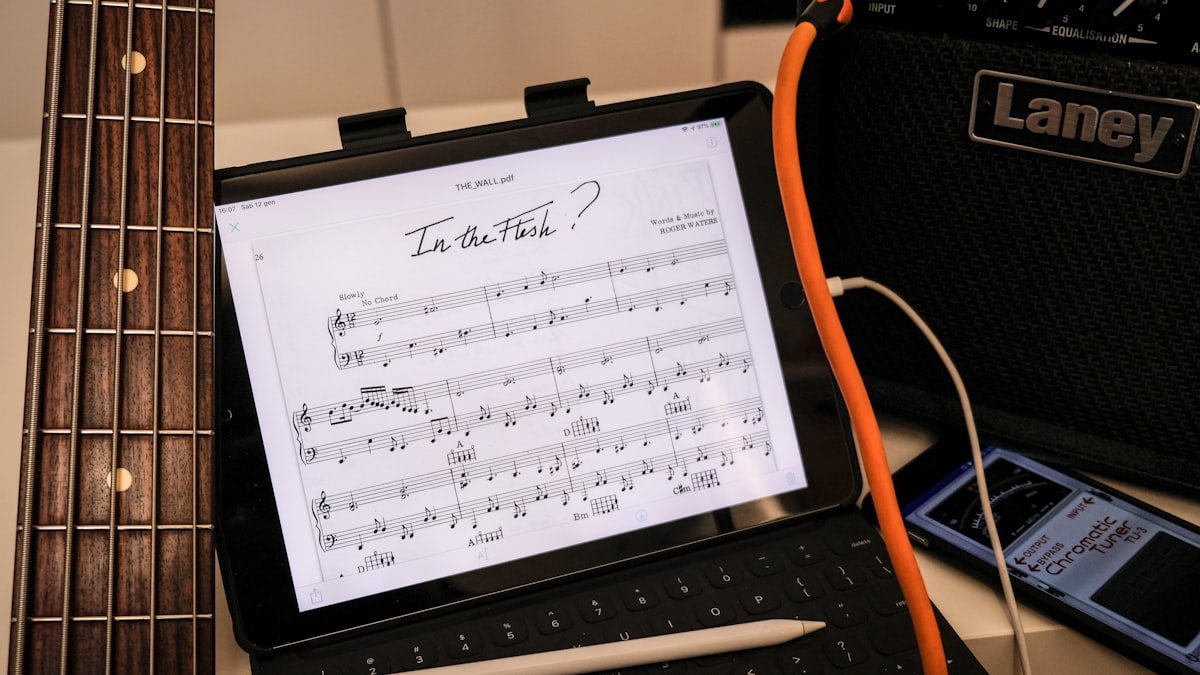
Going digital felt like progress — until everyone's screen was showing something different.
But it came with a problem nobody really talked about: everyone brought their own screen, and nothing talked to anything else.
Your guitarist is reading off their phone. You're on a tablet. Your vocalist pulled it up in a browser on a laptop. You're all scrolling independently, turning pages whenever you personally feel like it, possibly looking at completely different sections. One person scrolls ahead. Another gets lost and taps back three pages. Nobody actually knows what bar everyone else is looking at.
Going digital moved the chaos from paper to glass. The coordination problem was still there.
What every band rehearsal actually needs
When you strip it down, the thing musicians need is pretty simple: the same music, on every device, at the same time.
Not just the same file sitting in a shared folder somewhere. The same view, live. When the bandleader turns the page, everyone's screen turns. When someone marks a repeat or circles a passage, it shows up for the whole group. When you're jumping back to the bridge, nobody's hunting through a PDF while the rest of the room is already playing it.
The gap between "we all have the music" and "we're actually all on the same page" is where rehearsal time goes.
It's the kind of friction you stop noticing because it's always been there, but it adds up fast.
So we built SynchroJam
SynchroJam gives musicians a shared space to read and follow music together, in real time.
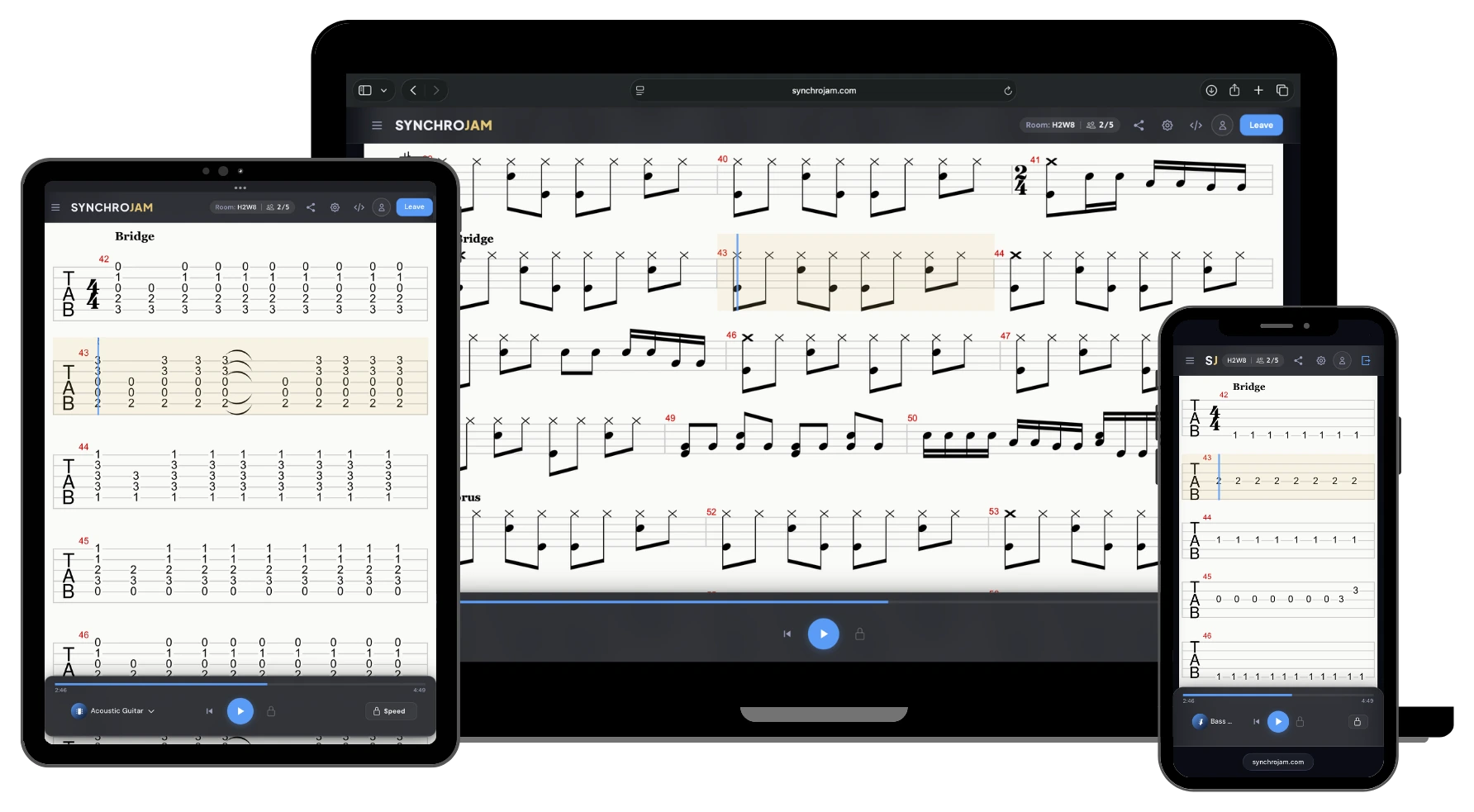
Same room, same bar, every screen — SynchroJam keeps everyone in sync across any device.
You open a Jam Room and anyone you invite joins in. Everyone sees the same music. When you navigate to a section, every screen follows. Annotations show up for the group. Nobody gets stranded on bar 32 while everyone else has moved on.
It's closer to actually working together than just sharing a file and hoping for the best. One is "here's a document, good luck." The other is being in the same room looking at the same thing.
Less setup, more playing
Getting a group of musicians aligned before they can actually play involves a lot of overhead that has nothing to do with music. Logistics, printing, file-sharing, people verbally calling out bar numbers, someone's phone dying at the worst moment.
SynchroJam cuts most of that out. Because everyone's looking at the same thing, you skip straight to playing.
Same goes for writing and arranging together. When one person makes a change, everyone sees it. No more emailing updated PDFs back and forth. No more "wait, are you on version 3 or version 4 of this?"
Why we built this
We kept hearing the same thing from musicians: they loved playing together, they just hated everything that happened before they could start.
That felt like a solvable problem. So we built SynchroJam to solve it, starting with the music stand.
If you play in a weekend jam band, a gigging ensemble, a studio session, or if you're a music teacher trying to keep thirty students on the same measure, SynchroJam is built for how you actually work: together, and in sync.